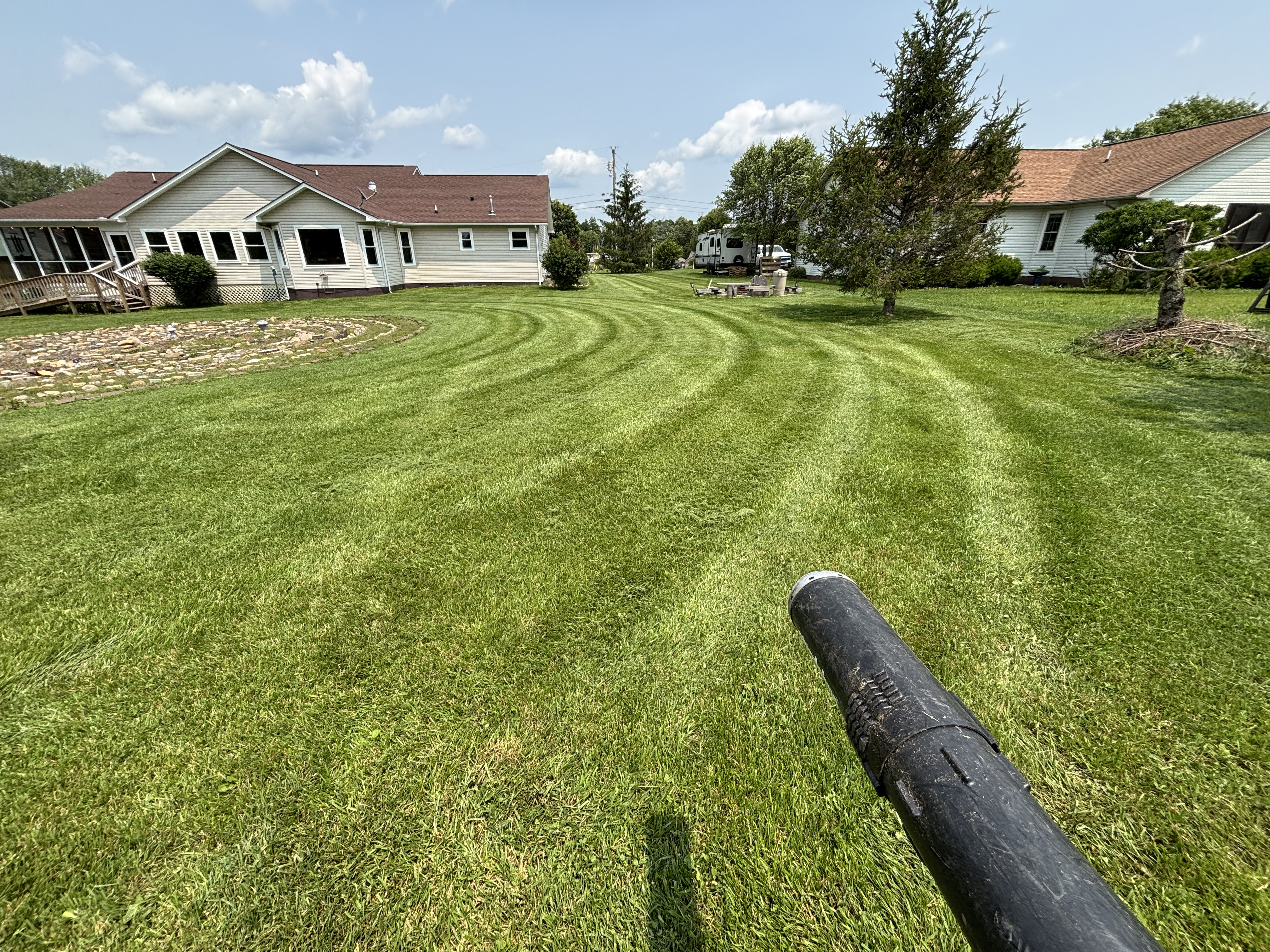
How to Care for Your Lawn After Installation
Watering, fertilizer, weed control, and a year-round schedule for new sod and seed on the Cumberland Plateau.
Installing sod or seeding a lawn is the easy part. What happens in the next thirty days decides whether that grass knits into a thick, dark lawn or thins out into a patchy mess by August. This is the schedule we give our own customers after a lawn install in Crossville, Cookeville, and across Cumberland County — watering, feeding, weed control, and what to do each season.
The one rule that matters most: water deep and less often. Short daily sprinkles grow shallow roots, and shallow roots are what die in a Tennessee July.
Watering: The First 30 Days
New sod has roots only as deep as the sod was cut. Until it knits to your soil, you are the root system.
2–3 short cycles a day
Keep the top inch moist at all times. Light and often — never let it dry out or puddle.
1 soak a day, 0.4–0.5 in
Roots are reaching down now. Water deeper and less often so they chase the moisture.
Every other day, 0.5–0.75 in
Do the tug test: if the sod lifts, back off. If it holds, start stretching the interval.
1–1.5 in per week, 1–2 deep soakings
Water early morning. One long soak beats five short sprinkles every time.
Fertilizer: Read the Bag
The three numbers on the bag are nitrogen, phosphorus, and potassium. For a new lawn, the middle number matters more than the first.
N — Nitrogen
Top growth and color
Goes down when grass is actively growing, never into summer heat on fescue.
P — Phosphorus
Root development
The one that matters most in the first 60 days after install.
K — Potassium
Stress and drought tolerance
Helps new grass survive its first Plateau winter and summer.
Fescue (cool season)
- SeptemberMain feeding — aerate and overseed, then starter fertilizer
- Late October / NovemberSecond feeding for root storage going into winter
- Late AprilLight feeding only, half rate, as it greens up
- June–AugustNo nitrogen. Water deep and spot-treat weeds instead
Bermuda / Zoysia (warm season)
- Late April / MayFirst feeding after full green-up
- June–JulySecond feeding at the higher rate
- SeptemberLast feeding of the year — stop 6 weeks before frost
- November–MarchDormant. Nothing goes down on the lawn
Mowing Rules
Height is free weed control. Fescue at 3.5–4 inches shades out crabgrass all summer.
3.5–4 in
Fescue height, spring and fall
4 in
Summer height on fescue
1/3 max
Never cut more than this per mow
Weed Control: Timing Beats Strength
Almost every weed problem we get called about is a timing problem, not a product problem.
1. Pre-emergent, on the calendar
The cheapest weed control you will ever buy. Apply in early March as soil temps hit 55°F and climb (crabgrass) and again in late September as they fall (winter annuals like chickweed and henbit). It has to be down before the seed germinates — after you see the weed, it is too late.
2. Post-emergent, spot only
On established grass, spot-spray broadleaf weeds on a calm day when temps are between 60 and 85°F. Never blanket-spray a new lawn, and never spray when the grass is heat- or drought-stressed. Two light passes beat one heavy one.
3. Culture beats chemistry
Mow tall, mow sharp, and feed on schedule. Fescue cut at 3.5–4 inches shades out crabgrass better than any bottle. A dull blade tears grass and opens the door for disease and weeds — sharpen it every 8 to 10 mows.
Do
- Apply pre-emergent in early March and late September
- Spot-treat only, on actively growing grass
- Leave clippings — they return nitrogen to the soil
Don't
- Blanket-spray weeds on a lawn installed this season
- Spray when grass is heat- or drought-stressed
- Use weed-and-feed on fescue in summer heat
The Year at a Glance
Built for fescue, which is what most Cumberland County lawns are. Warm-season notes are in the feeding table above.
Spring
March – May
- Pre-emergent by early March, before green-up
- Soil test; lime if pH is under 6.0 (very common here)
- First mow at 3.5 in — do not scalp the winter growth
- Spot-spray broadleaf weeds once grass is growing
- Light April feeding at half rate
Summer
June – August
- Raise the deck to 4 in to shade the soil
- Water 1–1.5 in a week, deep and early
- No nitrogen fertilizer — it feeds fungus and weeds
- Watch for brown patch after humid nights
- Never mow more than a third of the blade at once
Fall
September – November
- Core aerate and overseed fescue mid-Sept to mid-Oct
- Starter fertilizer at seeding, main feeding in Sept and Nov
- Pre-emergent late Sept for winter annuals
- Keep leaves off the new grass — they smother it
- Stay off frozen turf in late November mornings
Winter
December – February
- No fertilizer, no weed spray, no traffic on frozen grass
- Sharpen blades and service equipment
- Apply lime now if your soil test called for it
- Keep de-icing salt away from lawn edges and beds
- Book spring aeration early — slots fill fast
What is different about a Plateau lawn
Cumberland County soils are heavy clay and usually acidic, often sitting below 6.0 pH. Grass grown in that soil struggles to take up the fertilizer you paid for, which is why a soil test and a lime application do more for a new lawn here than an extra bag of nitrogen. Add the Plateau's cool nights and humid summers and you get two rules worth remembering: feed hard in fall, water deep in summer.
Lawn Care FAQs
For the first 10 days, two to three short cycles a day so the top inch never dries out. From day 11 to about day 21, one deeper soak a day. By weeks four to six, every other day at roughly half an inch. After week seven, treat it as an established lawn: 1 to 1.5 inches a week in one or two deep waterings, early morning.
Once the sod is rooted — usually two to three weeks in cool weather. Do the tug test: if a corner lifts easily, wait another week. Set the mower high, cut no more than a third of the blade, and make sure the blade is sharp so it cuts rather than tears.
New sod gets a light starter fertilizer at the first mowing, not before. New seed gets starter fertilizer at seeding, but no nitrogen until it has been mowed three or four times. Phosphorus and potassium are what new roots need; heavy nitrogen too early just burns tender grass.
Timing is everything. Standard pre-emergents will stop grass seed from germinating, so never apply one within four to six weeks of seeding. On new sod, wait until it is fully rooted and mowed twice. If you seeded this fall, skip the fall pre-emergent and hand-pull or spot-treat instead.
Shallow watering on heavy clay is the usual culprit. A five-minute daily sprinkle wets only the surface, so roots stay near the top and cook in July. Water deeply and less often, keep the deck high, and avoid pushing nitrogen in the heat. If the soil was compacted before install, core aeration the following fall makes a big difference.
Thin or shaded fescue benefits from overseeding every year or two, ideally mid-September to mid-October so it has time to establish before winter. A thick, healthy stand does not need it annually. Aerate first — seed dropped on hard, compacted ground mostly goes to waste.
Want a Lawn That Holds Up?
GleeWork installs sod, seed, and full lawn programs in Crossville, Cookeville & Cumberland County.
Get an Estimate
Luna
GleeWork Assistant · Typically replies instantly